Gas & Oil Vents

Regulations

The gas or oil vent must be installed to comply with Document J of the Building Regulations in England and Wales and part F of the Building Regulations in Scotland, for gas appliances having a flue gas temperature of 250°C max as well as to the flue manufacturer's installation instructions. The installation must also comply with BS5440 part 1:2000 for gas flues up to 60 kW in the UK. Only Gas Safe Register or OFTEC registered installers can commission the flue installation if the appliance is connected to the fuel supply.

Gas and Oil vents are manufactured, tested and approved to BS EN 1856 part 1

Flue Design

The Gas/Oil vent should remain as straight as possible and be high enough to ensure sufficient draught to clear the products of combustion (see termination details). Both vents are extremely adaptable, but excessive changes of direction and angles greater than 45° from the vertical in any flue system must be avoided, as they will create considerable resistance to the movement of the flue gases. Horizontal runs must never be used and always ensure that the first section of vent rises 600mm vertically from the top of the appliance.

The vertical distance between the appliance and the flue termination should always be twice the angled distance between the appliance and termination. In accordance with the Building Regulations, a minimum of 50mm distance to combustibles must be maintained.

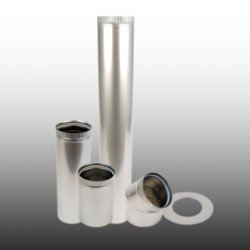
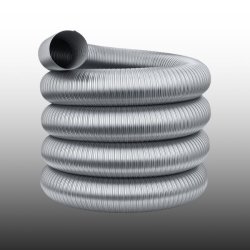
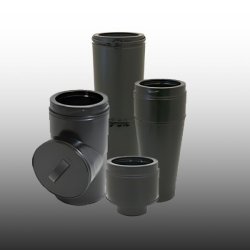
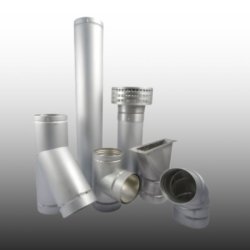
The Gas and Oil vents firestop/support components provide a 50mm clearance. At the maximum flue gas temperature of 250°C, the outer case will be in the region of 75-85°C Gas vent normally has an aluminium liner and a Zalutite outer skin with an air cavity, and can be used both internally and externally. However long external runs must be avoided and where external runs exceed 3 metres an insulated vent must be used. Oil vents have a stainless steel liner and are insulated. They are totally interchangeable with the Gas Vent without the need for adaptors. Any galvanised components used externally should be suitably weather protected.

Within both ranges there are adjustable lengths which can be used to telescope over a standard pipe length to provide the exact flue lengths required. It should not be used directly after a bend since there is insufficient overlap to insure a sound joint. A wall band must be used above an adjustable length as this component is not load bearing.

Always use an appliance connector to connect to the appliance, sealed using fibre rope and fire cement or high temperature silicone sealant.

Support Components

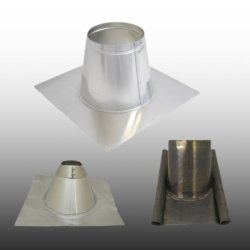
Internally run systems should be supported by using a support or ceiling support plate fixed on top of the floor/ceiling joists. Firestop plates are also required being fixed below the ceiling. Both components have purpose made lugs to ensure the 50mm distance to combustibles is maintained. Wall bands are not load bearing and give lateral support only. They should be fitted every 3m to ensure adequate support for the system. The maximum height unsupported above the roof line is 1.5m. Rigid stays or guy wires must be used if the installation terminates higher.

Appliance Removal

Use of an adjustable length immediately above the appliance enables removal of the appliance later without dismantling the full system.